
Workshops & Education
Bioplastics: Making Bioplastics from Algae Extracts with Surzhana Radnaeva
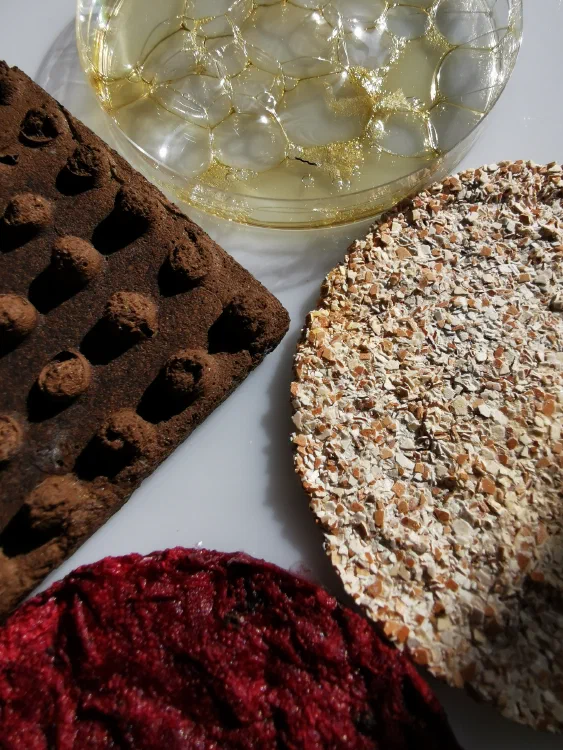
This workshop introduced participants to the world of biomaterials through the making of bioplastics and biocomposites derived from algae extracts.
Focusing on accessible, low-tech processes, it offered a practical starting point for understanding bio-based materials and their potential applications in design, fashion and everyday objects.
The session began with an introduction to the origin, composition, behaviour and properties of biomaterials, with particular emphasis on algae as a renewable and versatile natural resource. Contemporary applications and current challenges were also discussed.
Practical Exploration
Participants prepared and transformed algae extracts into bioplastic samples, investigating parameters such as:
- texture,
- flexibility,
- thickness,
- transparency,
- surface quality.
The workshop then expanded into biocomposites by incorporating locally available or residual materials such as eggshells, thread and yarn remnants, coffee grounds, orange peels and other clean organic residues. Natural dyes and essential oils were also used to create coloured or scented materials.
Participants completed the workshop with a personal collection of biomaterial samples and a practical understanding of bioplastics as an open field of experimentation shaped by available resources, curiosity and creativity.
Materials
All materials and necessary equipment were provided and included in the participation fee.
Instructor
Surzhana Radnaeva
Surzhana Radnaeva is a materials researcher, fashion designer and educator whose interdisciplinary practice bridges traditional knowledge with contemporary tools and experimental creation.
She is the founder of Traditional Futures, a project inspired by the preservation of her Indigenous cultural heritage from Siberia. Based in France, she works internationally across artistic, educational and research contexts.
Her research focuses on bio-based materials such as paper, algae, mycelium and bacterial cellulose, as well as handmade and mechanical production processes. Through garments, lectures and workshops, she explores how materials communicate their origin, time, wear and use in direct relation to the human body.
Teaching is an integral part of her practice and is approached as guided exploration. Her workshops create a space for focused experimentation where participants acquire material knowledge and develop skills through practice.
Would you be interested in a future edition of this workshop?
This workshop has already taken place. If you would like to attend a future edition, you can register your interest.
We will contact you if a new date is scheduled.
Registering your interest does not constitute a booking or guarantee a place.